
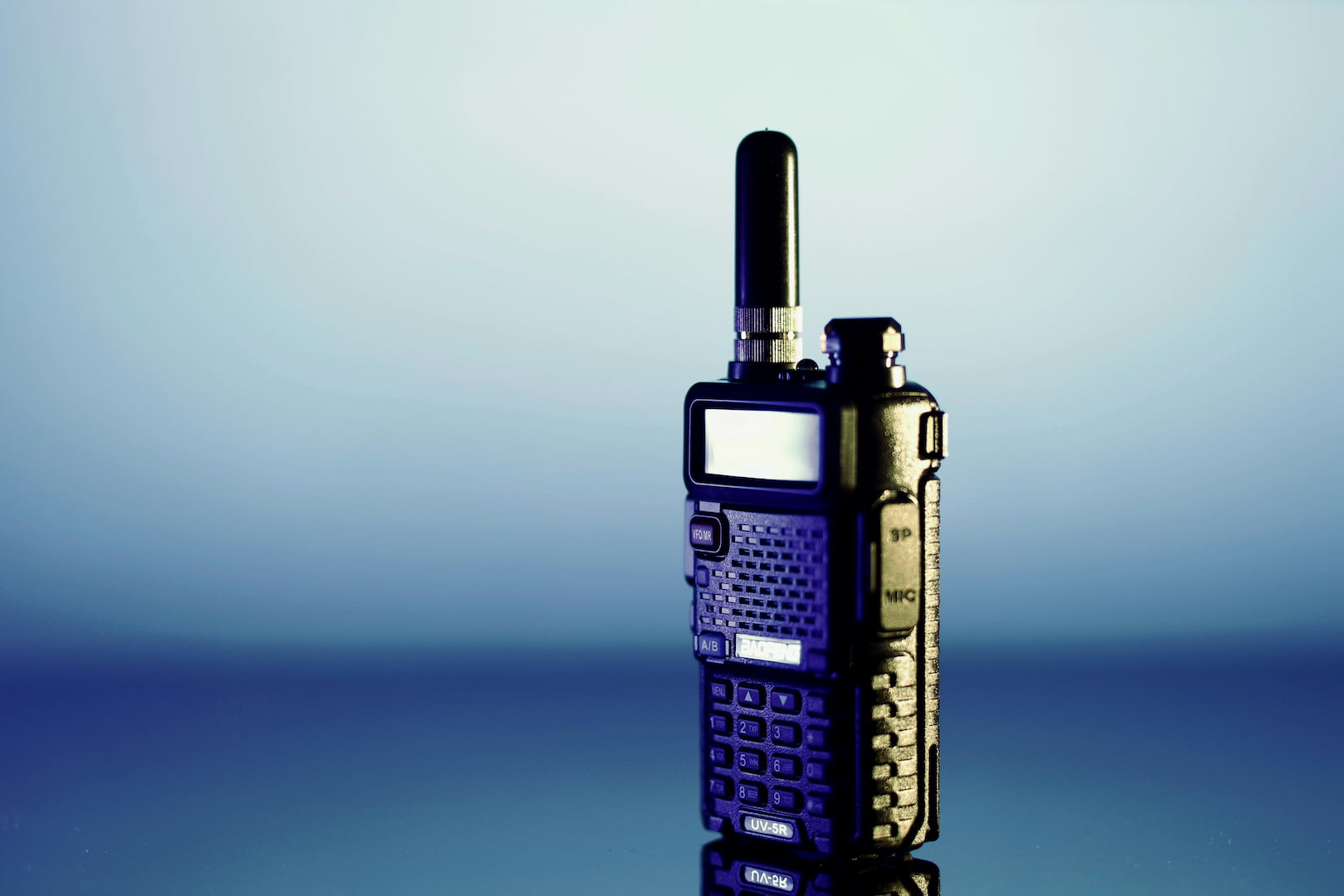
"50 km walkie-talkie", "Range up to 35 miles", "Long-range communication guaranteed": the marketing claims surrounding walkie-talkies regularly create expectations that are far removed from operational reality. For Canadian businesses equipping their teams, these figures can lead to unsuitable choices, or worse, safety issues when communication does not reach where it should.
This article separates myths from realities on walkie-talkie range, explaining what actually influences communication distance. Accès Communications, as a specialist in two-way radio rental and sales, is regularly consulted to validate expected coverage on a given site, and daily observes the gap between commercial promises and actual field performance.
Where the Numbers on the Box Come From
The ranges advertised by manufacturers are measured under optimal conditions: perfectly clear terrain, no obstacles, optimal antenna height, full battery, and favourable atmospheric conditions. A "50 km walkie-talkie" can genuinely reach that distance from mountaintop to mountaintop, with zero obstruction.
On a real site, whether a construction site, factory, industrial park, or urban area, conditions are radically different. Buildings, metal structures, vegetation, terrain variations, and interference drastically reduce effective range. The same device rated at 50 km can function at just 1.5 km in dense urban environments. These specifications are not false, but they do not reflect daily professional use.
The Role of Frequency: UHF, VHF, and Beyond
The frequency used is one of the most determining factors of effective range. VHF (Very High Frequency, 136-174 MHz) frequencies propagate better in open spaces, making them the preferred choice for rural, forestry, or maritime operations. UHF (Ultra High Frequency, 403-512 MHz) frequencies penetrate physical obstacles such as buildings and metal structures better, making them more suited to urban and industrial environments.
The choice between UHF and VHF must therefore be driven by the operating environment, not by an assumption about range. A UHF radio in a sawmill or mining complex will often provide better coverage than a more powerful VHF radio that is less suited to structure penetration. For operations that combine open spaces and buildings, a hybrid system or a digital network with repeaters may be necessary.
Transmit Power: Useful but Limited
Transmit power, expressed in watts, plays a role in range, but its impact is often overestimated. Professional portable radios typically transmit between 1 and 5 watts, while mobile radios installed in vehicles can reach 25 to 50 watts. However, doubling transmit power does not double range: radio wave propagation follows a decay curve that produces diminishing returns beyond a certain threshold.
In the field, two radios with very different power levels can offer comparable range in an obstructed environment, because the limiting factor is attenuation by obstacles, not transmit power. This is why operations in manufacturing or construction environments often rely on repeaters or a digital network rather than simply increasing radio power.
The Antenna: An Often Overlooked Factor
The antenna is one of the most decisive elements of range, yet one of the least understood. A poorly matched, damaged, or low-quality antenna can dramatically reduce the performance of an otherwise excellent radio. Conversely, a good antenna can transform the coverage of modest equipment.
For portable radios, the antenna type (flexible stub, helical, half-wave) directly influences radiation patterns. For mobile or fixed-station radios, the height and orientation of the antenna play a major role: doubling the height of an external antenna often has more impact on range than doubling transmit power.
Environment and Terrain
Terrain is the most visible factor influencing range. In open spaces (sea, plains, cross-country skiing, golf), range can approach theoretical values, provided there is line of sight. In wooded, mountainous, or urban environments, it drops dramatically.
Several factors degrade propagation: dense vegetation (especially when wet), metal structures (warehouses, steel frames), reinforced concrete, vehicles, and iron-rich soils. Atmospheric conditions can also play a role: humidity, fog, and heavy precipitation affect signals to varying degrees depending on frequency. On any given site, only an actual measurement establishes effective coverage, which justifies a coverage test before deploying a large fleet.
The Difference Between Simplex and a Repeated System
Simplex communication occurs directly from radio to radio, with no intermediary. Range is then limited by both devices' characteristics and the environment between them. This is the simplest mode, but also the most limited in range.
A repeated system uses a repeater installed at height, which receives radio transmissions and retransmits them at full power. This configuration multiplies usable range considerably: a portable radio covering 2 km in simplex can cover 30 to 50 km through a well-positioned repeater. This is the principle behind digital networks deployed in transportation, large-scale events, and municipal services. For truly extended or inter-regional distances, LTE or hybrid solutions are also available.
How to Estimate the Range Your Operation Needs
The estimate starts with a needs mapping: where must teams communicate, at what distances, in what environments, and how frequently? A film production on a covered set and a forestry, mining, or petroleum operation spanning hundreds of hectares do not have the same requirements, even if the "range" requested sounds similar in kilometres.
Once needs are identified, several options should be evaluated: frequency selection, power level, antennas, use of a repeater, digital network configuration, LTE integration for extended areas. A coverage test on the actual site, conducted with the equipment under consideration, remains the most reliable method to validate the solution. This is especially true for critical operations where a loss of communication can affect safety, such as emergency and security services.
Key Takeaways
- Ranges advertised by manufacturers are measured under ideal conditions and do not reflect real professional use.
- Frequency (UHF vs VHF) often has more impact on effective range than transmit power.
- Power plays a limited role: doubling watts does not double range.
- The antenna is a critical but often neglected factor: its quality, type, and height radically change performance.
- Environment (buildings, vegetation, terrain) is the primary factor in signal degradation.
- A repeated system or digital network considerably multiplies usable range compared to a simplex system.
- A real coverage test on the site remains the most reliable method to validate a solution before large-scale deployment.
- For very extended or inter-regional distances, LTE/PoC solutions offer virtually unlimited range wherever cellular coverage exists.
Frequently Asked Questions
What is the maximum range of a professional walkie-talkie?
In direct (simplex) communication, a professional portable radio offers a practical range of 1 to 5 km in urban or industrial environments, and 5 to 15 km in open terrain. With a well-positioned repeater, usable range can reach 30 to 50 km or more depending on the deployment.
Why do packages advertise 50 km of range?
These figures correspond to measurements taken under perfect conditions: summit to summit, no obstacles, ideal weather. In normal professional use, range is far lower and depends heavily on terrain, buildings, and the environment.
Does a more powerful radio carry further?
Partially. Power influences range, but with diminishing returns. A 5W radio does not carry five times further than a 1W radio. Antenna type, frequency, and environment often have more impact than power.
UHF or VHF: which carries further?
Neither frequency is inherently superior. VHF is more effective in open terrain, UHF penetrates obstacles and buildings better. The right choice depends on the environment, not raw range.
How do I extend the range of a walkie-talkie?
Several options exist: install a repeater, use a higher-quality external antenna, select the right frequency for the environment, choose an LTE radio for areas with cellular coverage, or deploy a digital network.
Should coverage be tested before purchasing a fleet?
For significant deployments or critical operations, yes. A site coverage test validates the solution and avoids discovering dead zones after installation. An authorized dealer can typically organize this type of test.