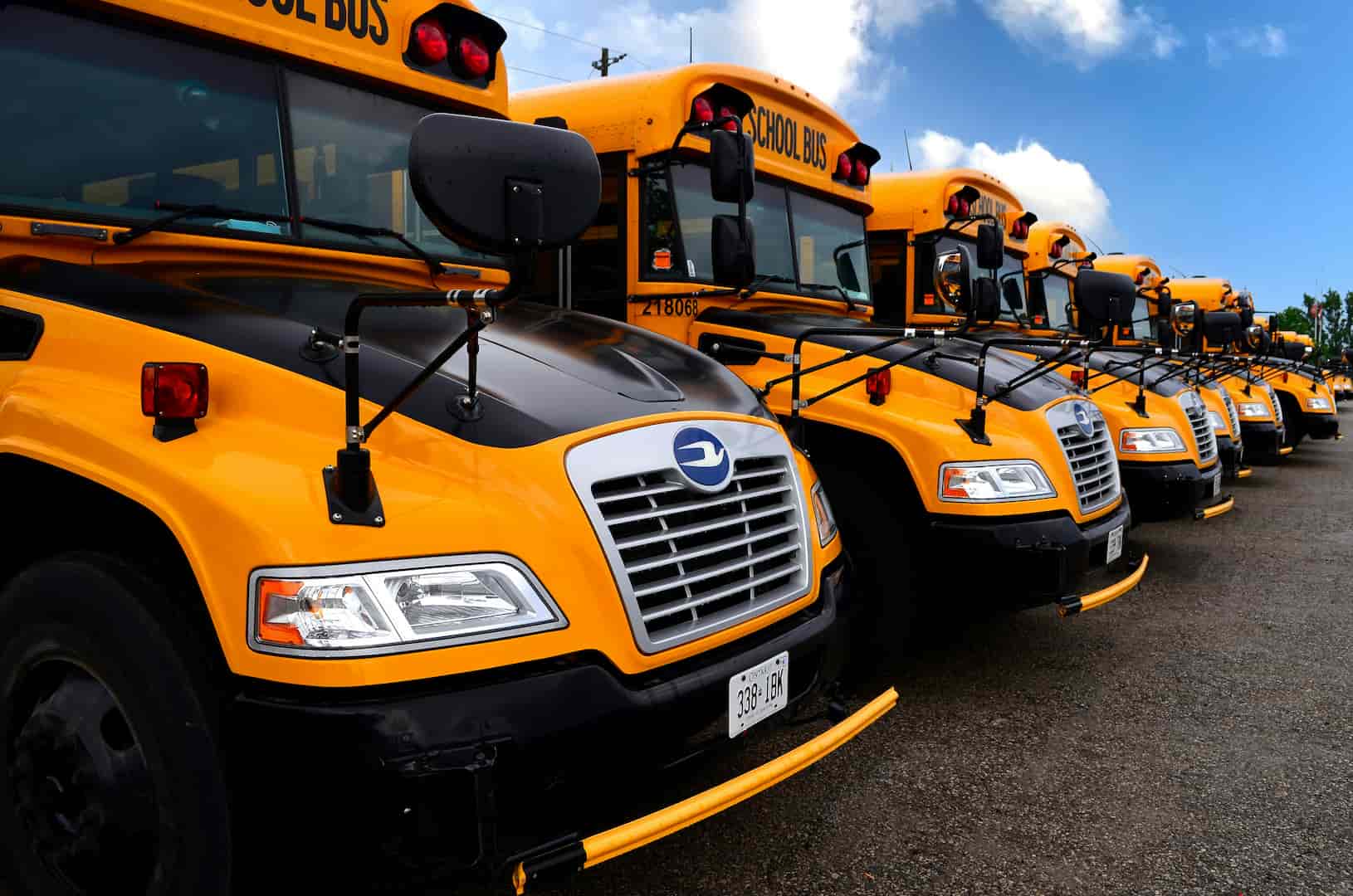
School transportation is one of the most demanding communication environments. Every day, hundreds of buses operate under variable conditions, weather, traffic, back roads, rural zones, carrying the most vulnerable population: students. Reliable coordination between drivers, dispatchers, and supervisors is not an operational luxury; it is a safety requirement.
Two-way radios remain the reference tool for ensuring this coordination, despite the ubiquity of mobile phones. This article covers the specific challenges of school transportation, the features to prioritize when choosing a radio solution, the applicable regulatory obligations, and the practices observed in the best-equipped operators. Accès Communications, as a specialist in two-way radio rental and sales, supports several school transportation operators across Canada in deploying their fleets.
Why Radio Remains Essential Despite Mobile Phones
The natural reflex is to assume that the mobile phone, present in every pocket, is sufficient to cover a carrier's communication needs. In practice, this is not the case, for several operational reasons.
First, road safety: a two-way radio is used with one hand, using a single button (PTT), without screen manipulation or searching for a number. The driver can transmit a message without taking their eyes off the road, which aligns with the safety requirements imposed in the sector. Second, group communication: a radio message is heard instantly by all relevant drivers, without individual calling. Third, reliability: rural areas and some road corridors have cellular coverage gaps, where a dedicated digital radio network can guarantee continuous coverage.
School Transportation-Specific Safety Challenges
School transportation combines several risk factors that make communication critical. Frequent stops in residential areas, intersections with other road users, Canadian winter conditions, unpredictable behaviour from young passengers, and routes covering both urban and rural environments: all situations where information transmitted quickly can make a real difference.
Several recurring scenarios illustrate this need. A driver who must report a delay, an incident on board, a vehicle parked blocking a stop, or deteriorating road conditions. A dispatcher who must alert the entire fleet to a detour, school closure, or weather situation. An emergency, an accident, a medical issue on board, behaviour requiring intervention, where every second counts. In these cases, radio provides an immediate, shared, and documentable communication channel that supports emergency protocols and integrates with emergency and security services practices.
Features to Prioritize for School Transportation
Several technical characteristics are particularly relevant for school transportation fleets. Audio quality in noisy environments is essential: a moving bus generates significant ambient noise, and the radio must remain intelligible. DMR digital radios have a clear advantage here, with their background noise reduction and constant clarity.
Other features are strongly useful. Automatic identification (PTT ID) allows the dispatcher to instantly know which bus is transmitting, without a verbal identification. Integrated GPS tracking facilitates fleet monitoring, route verification, and incident response. Emergency alerts allow the driver to signal a critical situation with a single action, triggering a pre-programmed procedure. Text messaging offers a discreet voice alternative for transmitting information that does not require an immediate response, as we discussed in our article on migration to digital networks.
Choosing Between a Mobile Radio and a Portable Radio
In a school bus, two configurations are possible. A mobile radio is permanently installed in the vehicle, powered by the bus battery, with an external antenna for optimal range. Its transmit power (generally 25 to 50 W) gives it significantly greater coverage than a portable radio.
A portable radio offers useful mobility in certain situations: a driver who needs to communicate outside the vehicle (inspection, intervention), field supervisors, support teams. Several operators combine both: a mobile radio fixed in each bus for primary communication, complemented by a portable for occasional needs. The choice depends on internal protocols, the operating model, and budget. A prior discussion with an authorized dealer generally helps make an informed decision.
Applicable Regulatory Compliance
As with any professional radio operation in Canada, school transportation is subject to Innovation, Science and Economic Development Canada (ISED) regulations. A radio licence is generally required for UHF or VHF frequencies used, with standard obligations: compliance with assigned frequencies, power limits, and use restricted to professional communications.
Added to this are the school transportation-specific requirements imposed by provinces and school boards: emergency communication protocols, incident documentation, driver training on radio procedures, and integration with school emergency plans. Some jurisdictions also regulate the use of headsets and earpieces to ensure drivers maintain full auditory awareness of their environment. These local requirements should be validated with the relevant authorities when deploying a new solution.
Integration with Fleet Management Tools
Modern school transportation operators are increasingly equipping themselves with integrated management systems: GPS tracking, route monitoring, parent communications, incident management, and operational reporting. DMR digital radios integrate with these ecosystems through software gateways that turn the radio into a data source for the central system.
This integration opens interesting operational possibilities. A delay reported by radio can be automatically transmitted to parents by text message. An emergency alert activates the radio, GPS system, and dispatcher dashboard simultaneously. Communications can be archived for incident analysis. These capabilities, once reserved for large operators, are now accessible to carriers of all sizes through the maturity of available solutions in the transportation and school transportation sector.
Rental: A Relevant Option for Seasonal Peaks
The school transportation calendar creates activity peaks (back to school, educational outings, special event transportation) and quieter periods. For occasional needs, coverage of a school event, temporary equipment replacement, or fleet expansion for a particular activity, radio rental offers useful flexibility.
Professional suppliers provide pre-programmed equipment under active licence, ready for rapid deployment. This option avoids the investment for occasional use and allows testing solutions before a potential purchase. It is also an effective response for carriers who handle film productions, event-related activities, or special transportation in addition to their primary school activity.
Key Takeaways
- Two-way radio remains indispensable in school transportation despite the ubiquity of mobile phones, due to its ease of use while driving, group communication capability, and reliability in areas with poor cellular coverage.
- The specific challenges (vulnerable students, frequent stops, winter conditions, rural routes) make communication critical for safety.
- DMR digital radios offer essential features: audio quality in noisy environments, automatic identification, GPS, emergency alerts, text messaging.
- The combination of a mobile radio (installed in the bus) and a portable radio (mobility) covers most operational needs.
- Operations are subject to ISED regulations as well as provincial and school board-specific requirements for student transportation.
- Radio + GPS + management system integration opens advanced use cases (monitoring, automatic alerts, incident archiving).
- Radio rental is a relevant option for seasonal peaks and occasional needs.
- A real coverage test on actual routes remains the best method to validate a solution before full deployment.
Frequently Asked Questions
Why use a radio instead of a mobile phone in a school bus?
Two-way radio is operated with one hand using a single button, which is safer while driving. It enables instant group communication to all relevant drivers, and remains reliable in areas with weak or variable cellular coverage.
Is a radio licence required to equip a school bus fleet?
Yes, in most cases. Using dedicated professional UHF or VHF frequencies requires an ISED licence, except for LTE/PoC solutions that operate through existing cellular networks. An authorized dealer can assist with the application process.
What range is needed for school transportation?
It depends on the territory covered. In rural areas with extended routes, a digital network with repeaters is generally required to guarantee continuous coverage. In urban environments, simplex mobile radios may suffice depending on fleet density. A coverage test on actual routes remains the best validation method, as explained in our article on real walkie-talkie range.
What features are essential in a school transportation radio?
The most relevant are: audio quality in noisy environments, automatic identification (PTT ID), integrated GPS, emergency alert button, text messaging, and compatibility with a central fleet management system.
Should there be one radio per driver or one radio per vehicle?
The most common practice is a mobile radio fixed in each bus (for primary communication), with a few complementary portable radios for supervisors and occasional off-vehicle needs.
Can radios be rented for the school year start?
Yes. Two-way radio rental services are suited for seasonal peaks such as back to school, educational outings, and special events. Equipment is provided pre-programmed and under active licence, ready for immediate deployment.